For writers who want to write, not prompt
Take the risk.
Keep every word.
Origin Draft gives screenwriters what film software never has: real version control, made visual and simple. Branch the dangerous idea, compare it against the draft you trust, and bring back only the scenes that earned it. It's local-first and private: your script lives in plain text files on your own computer, and it stays yours.
Private alpha on macOS · Windows & Linux in development · Free during early access · See what works today
In a hurry? The writer survey guarantees you a place in the next batch.
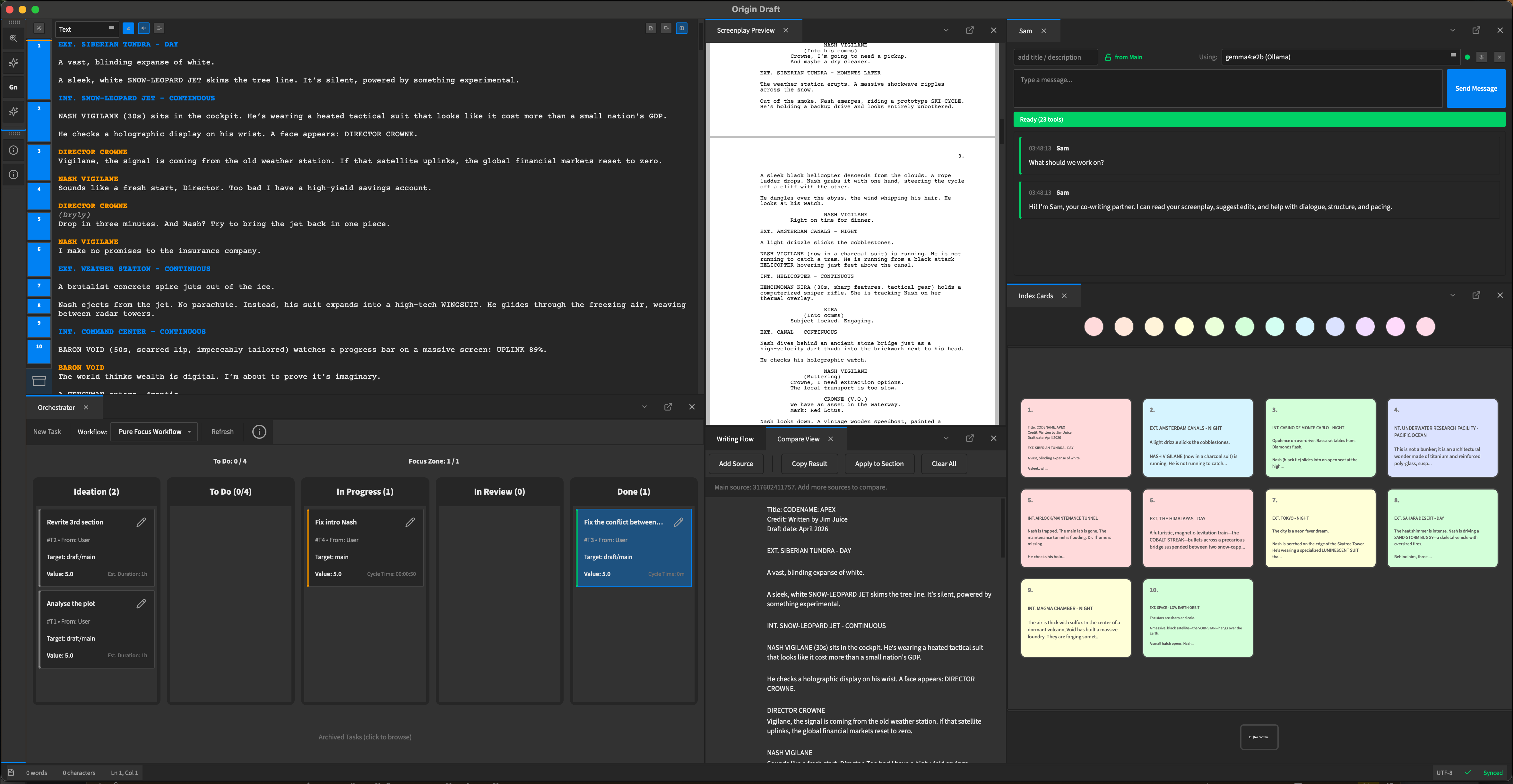
The writing view: your script beside the finished page. Everything else stays out of the way until you ask for it.
- Plain text, zero lock-in
- Writing works offline
- Final Draft · Fountain · Word · PDF
- Complete version history
- AI on your own machine
Version control
Every rewrite can be brave.
Try a different ending. Restructure the second act. Follow the dangerous idea. Origin Draft holds the version you trust while you explore the version that might be better, and it shows you the difference in the only place that matters: on the page. Here's the whole workflow.
- 01 Duplicate the current draft as “Darker ending”.
- 02 Rewrite freely. The main draft is untouched.
- 03 Compare the two versions side by side, scene by scene, with every change marked.
- 04 Combine them. Take this scene from the experiment, that speech from the original, line by line if you want it that precise. Nothing lands without your approval.
- 05 Keep the experiment for later, or drop it. Either way, every version stays restorable.
When your producer asks about that version from three weeks ago, you have it before the call ends. Final_v3_REAL.fdx is dead.
Under the hood it's Git, the system that versions the world's software. You never see it. You see drafts, checkpoints and comparisons.
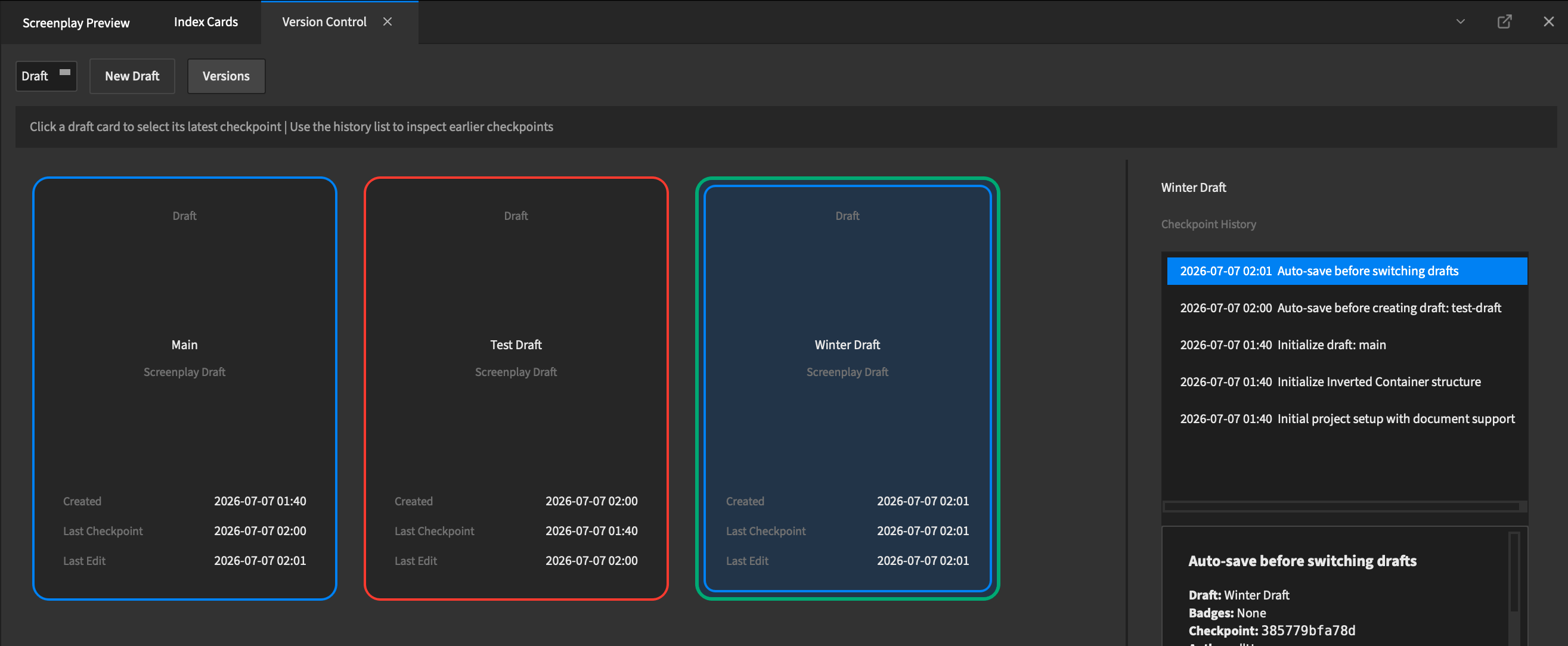
The real thing: drafts as cards, every checkpoint listed, any of them restorable.
Eighteen months. Not one lost word.
Through eighteen months of building this application and every alpha round since, Origin Draft has not lost a writer's word. Not to a crash, not to a bad merge, not to a rewrite that went wrong. That is the point of putting version control underneath a screenwriting tool instead of bolting autosave on top of one.
Proof you wrote it, rather than prompted it.
A screenplay's history is very hard to fake, and Origin Draft keeps yours in order: every checkpoint, every branch, every idea you tried and abandoned, with the hour you made each one. If your authorship is ever questioned, and it will be for somebody, the record of how the script actually came about is sitting in your project folder. Months of wrong turns look nothing like a prompt.
Ideas, then pages
Bring the ideas together. Then write the one you can't put down.
Most stories start long before page one, in fragments: an overheard line, an article, a character with no plot attached. Origin Draft gives those fragments somewhere to live and grow, so that when you commit to a script you are choosing between real material rather than guessing.
01
Gather
Research, notes and half-formed ideas go in as you find them, connected to the work instead of scattered across seventeen browser tabs and three notebooks.
02
Evolve and choose
Ideas grow, collide and combine. When one of them has enough material behind it, you'll know, and you can start the script you're actually passionate about.
03
Write, then rewrite
Move into drafting without switching apps or losing the thread. Index cards for structure, writing flow for momentum, page preview for the format. Same draft, different windows onto it.
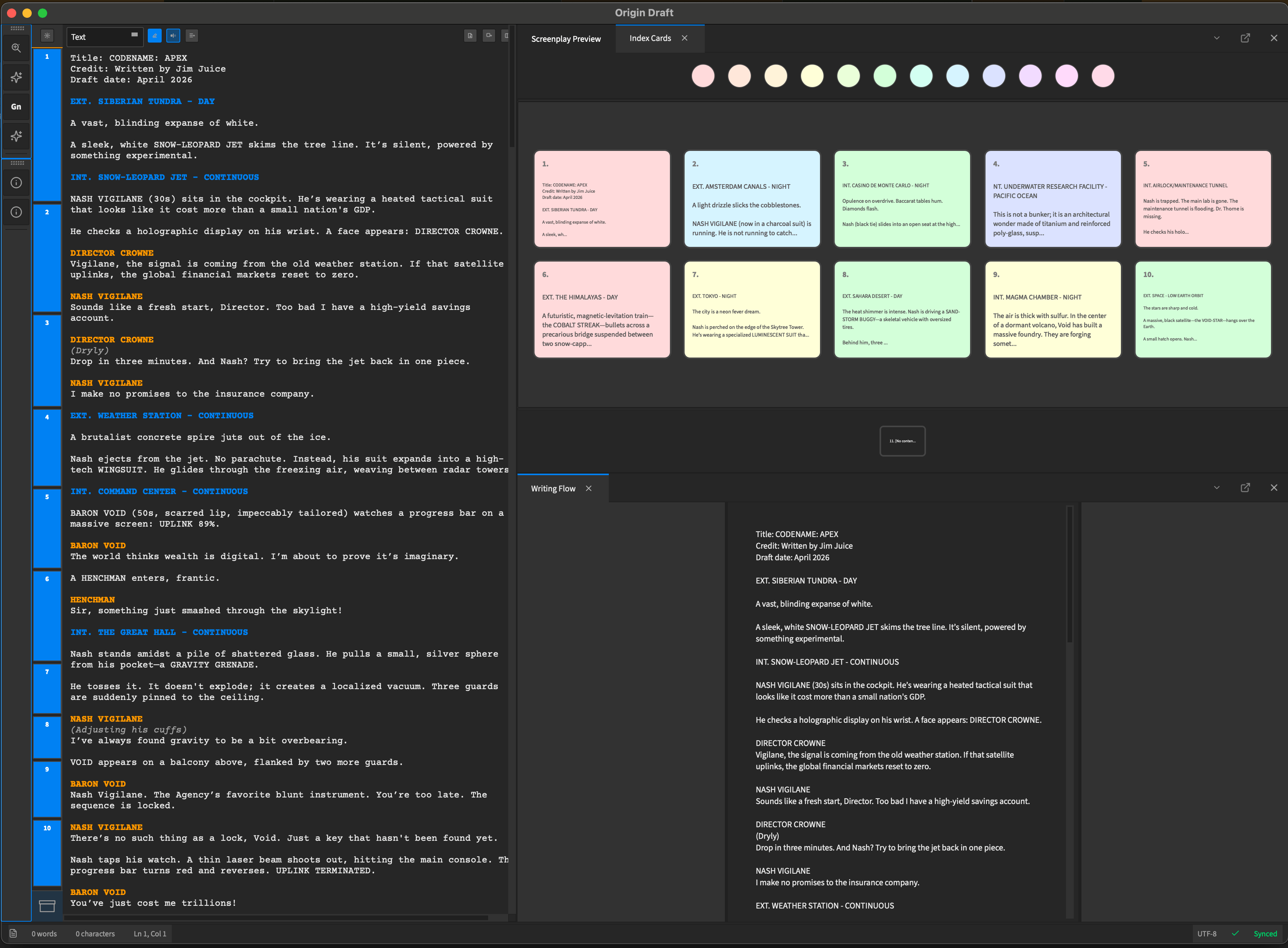
Everything stays connected: editor, index cards and writing flow are views of the same draft. Every panel is optional. Start from the page and open the rest when you need it.
Active search
Find the line. Fix it where you found it.
Search the whole script by keyword or by meaning, and get back the passages themselves rather than a list of page numbers. Every result is live: rewrite it straight from the search view and the change lands in the draft.
Ask for “the scenes where she lies to her brother” and semantic search finds them even when nobody says the word lie. Then work through them as one list, in one pass, instead of hunting the file top to bottom.
Results hold still while you edit inside them, so rows never move under your cursor.
Script research
A research desk that belongs to this script.
Sources, interviews, timelines, the technical details you can't get wrong: they get their own view, in the project, beside the draft. Not a folder of PDFs you'll never open again.
The interface is built for material that keeps changing. As the script evolves, it helps you see what your research still supports and what has quietly gone stale, so the world of the story stays consistent with itself.
Research notes are plain text in the project folder, like everything else.
Zero lock-in
Your project is a folder.
A plain folder of text files on your own computer, with the complete version history inside it. No account stands between you and your own script. No proprietary container that needs our software to open.
Open it in any text editor. Back it up with whatever you already use. And if you ever leave, you leave with everything, in a format that will still open in twenty years.
Cloud sync is there if you want it, switched on per project and pointed at your own account. What travels is the whole revision history, not just the latest file, so the copy off your machine can restore any version you ever had. Leave it off and nothing goes anywhere.
my-film/
- content/
- every scene, plain text
- notes/
- notes and research
- .git/
- complete version history
- .origindraft/
- project settings
Readable with any text editor. Versioned with the same technology that protects the world's software. Yours on any backup you already use.
Formats
- Final Draft (.fdx) Import & export
- Fountain Import & export
- PDF Import & export
- Word (.docx) Import
Word export is on the list. More formats follow as writers ask for them.
Standards
Hop on. Hop off.
Origin Draft is built on the formats and working practices the industry already runs on, so it doesn't ask to own your pipeline. Bring in a script that started somewhere else, do the rewrite here, and hand back the file the room expects.
Use it for one difficult pass or for the whole film. Your collaborators never have to know which tool you used, and they never have to install anything.
AI, on your terms
The AI works for the writer. Not the other way around.
Most AI writing products are cloud-first and built to generate prose. Origin Draft is local-first and built to support the writer's decisions: it analyses, researches and reports back, and the writing stays yours.
Local models do the work
Analysis and reporting run through a local model runner on your own machine. You install it and download a model once. Your script is never sent to anyone's servers without your say so.
Or bring your own key
Slower computer, or want a bigger model? Connect your own API key and use that instead. The script travels only to the account you connect, only when you invoke it.
Nothing enters the script without you
Agents research, analyse and give honest feedback. They do not write your pages. Only your hand puts words in the draft.
What runs where
Local AI connects to a local model runner such as Ollama, entirely on your machine. Setup means installing the runner and downloading a model once.
Curated models arrive in the app automatically. We keep a short list of the models actually worth running, updated as new ones land, so you don't have to follow the release notes of an entire industry.
Your own key is optional and opt-in. Your script goes only to the accounts you connect. Origin Draft never falls back to a cloud model on its own.
Fully offline is a first-class choice, and a good one. Writing, formatting, versioning and local AI all work with the internet switched off, and the editor is a complete tool with AI turned off entirely.
For writers who want to write, not prompt.
Analysis and reporting
See the draft from another angle.
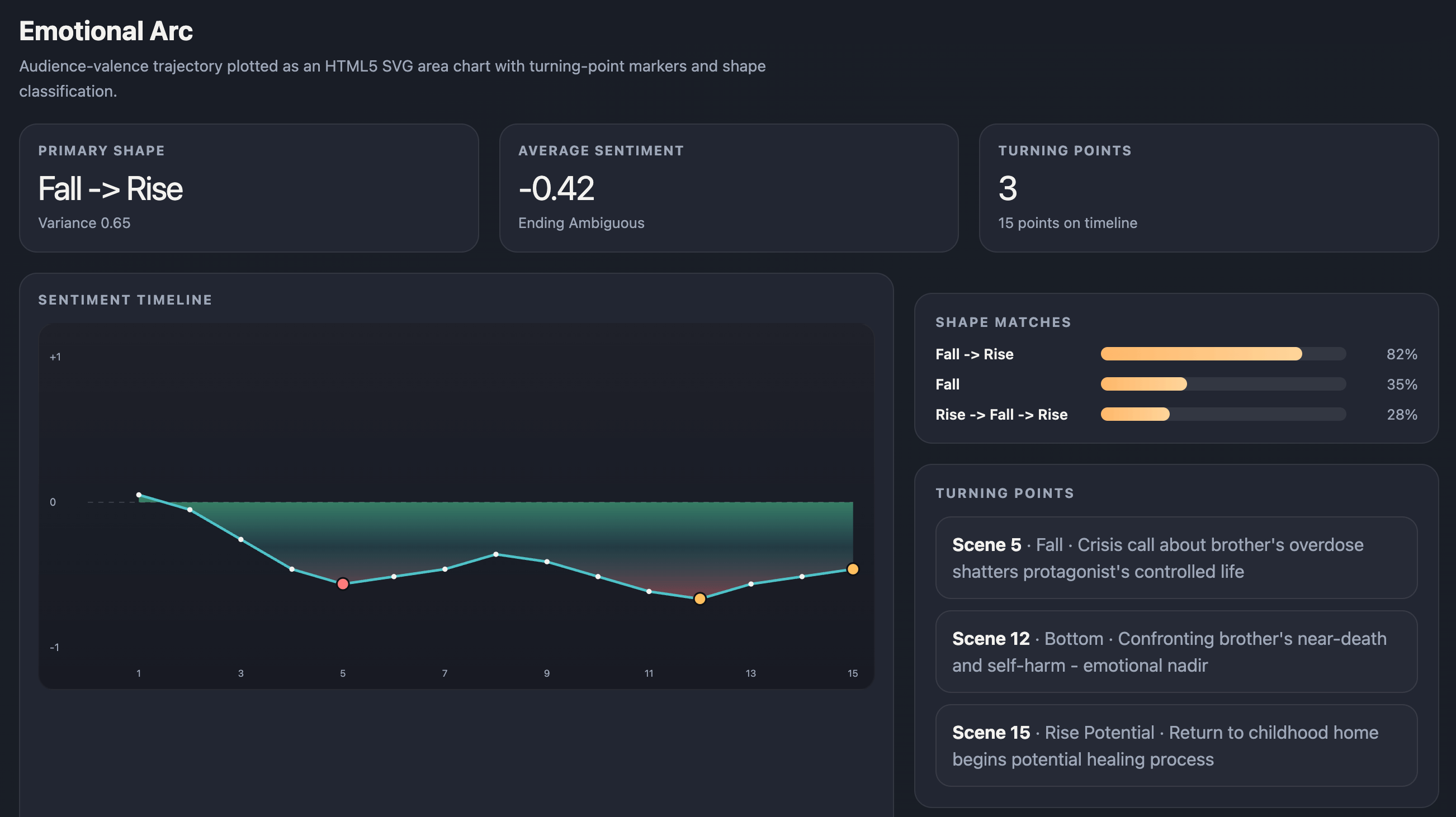
Every writer knows the feeling: something is off, but you can't point at it. Diagnostics plot pacing, character presence, dialogue balance and emotional movement across the script, building on published narrative research such as story-shape and sentiment-arc analysis. The reports run on your machine, on local models, on a script that never leaves the building.
They are instruments for reflection, not judges. A diagnostic surfaces a signal: a pattern, a possible turning point, an imbalance. The writer decides what it means. No instrument scores your talent, and none can tell you whether a scene is good.
We're documenting each instrument's methodology during early access: what it measures, where the idea comes from, and what it can't tell you.
Draft Anchor
In developmentAnchor a version in time.
Draft Anchor creates a tamper-evident timestamp for the exact version in front of you, written to an independent public ledger. It can later help demonstrate that this file existed no later than that moment, without publishing or uploading the screenplay itself. It's part of Origin Draft, because in the age of AI, proving you wrote it and when is a right, not a premium feature.
01
Fingerprint
Origin Draft computes a cryptographic fingerprint of your version. The fingerprint is what gets recorded, never the script itself.
02
Timestamp
The fingerprint receives an independently verifiable timestamp, fixing that exact version to that exact moment.
03
Verify
Anyone can later confirm that your draft matches the record: evidence this exact version existed by that date.
You can let anyone verify a draft without Origin Draft, so the claim can be checked, not just believed.
Anchoring gives you strong, verifiable evidence of when a version existed. It supports provenance; it is not a substitute for copyright registration or legal advice.
Two versions
Origin Draft, and the version that runs ahead of it.
Origin Draft is the application: stable, supported, free during early access, and yours through the waitlist. Research Review is the experimental build that goes to Many Monkeys Substack supporters, carrying ideas that may never reach a stable release. Today that means a fleet of agents running as your staff, and web and mobile surfaces so the work carries on when you're nowhere near the desk.
Early access
Origin Draft
The whole application, not a trial. Free during early access.
- Professional screenplay editor with page preview, index cards and writing flow
- Complete version history: branch, compare, combine, restore
- Keyword and semantic search you can edit straight from
- Script research view with living, connected notes
- Final Draft, Fountain, PDF and Word exchange
- Local AI analysis and reporting, or your own API key
- Optional cloud sync to your own account, carrying the whole revision history
- A verifiable record of how the script came about, if your authorship is ever questioned
- Draft Anchor timestamping (in development)
Builds go out in small batches. The writer survey guarantees you a place in the next one.
Substack only
Research Review
The workshop build. Everything above, plus the experiments, some of which will never ship.
- Everything in Origin Draft
- The complete diagnostic suite running on your pages
- A fleet of agents working as your assistants and secretaries, never as your replacement
- Specialist feedback agents for dialogue and structure
- Proactive assistance that files suggestions as tickets instead of interrupting you
- Web and mobile surfaces: catch an idea, write a scene or set an agent going from anywhere
- Vision Explorer: moodboards and concept art linked to the draft
- Whatever was built that week, including the parts that get cut
Research Review builds reach paying Substack readers and nobody else. There is no other way to get one, and no plan to sell them separately.
Research Review is unsupported and unstable by design. Things break, features vanish between builds, and some of the best ideas in it will never make it into Origin Draft. That's what makes it worth reading about. You're funding the workshop, not buying a product, and the application itself is never subscription-gated.
Writer research study
Skip the queue.
Builds go out in small batches, and the waitlist is longer than the batches are. Complete the writer survey and your place in the next batch is guaranteed, ahead of the general list.
It's a real research study, not a form. We're mapping how working screenwriters actually work: the tools, the workarounds, the places it all falls apart. Your answers decide which problems get solved first. It takes 15 to 20 minutes, and anything that doesn't apply to you can be marked not applicable.
You also get the findings report when it's published, and a place in the credits if you want one.
Take the writer surveyFor working writers and writer-filmmakers. Your answers are used only for this research and never shared individually. Privacy policy
Build status
What works today.
Early access means unfinished. Here is exactly where the build stands, updated as each cohort goes out. Testers tolerate rough software, not vague software.
- Screenplay editor & formatting Private alpha (macOS)
- Windows and Linux builds In development
- Draft branching, checkpoints & restore Working alpha
- Draft comparison & combining scene by scene Working alpha
- Keyword search with in-place editing Working alpha
- Semantic search Experimental
- Script research view Working alpha
- Final Draft, Fountain and PDF exchange Working alpha
- Word import Working alpha
- Optional cloud sync with full history Working alpha
- Local AI analysis & reporting Experimental
- Draft Anchor Designed, not yet shipped
Detailed build logs, including what broke, are published on the Many Monkeys Substack.
Why this exists
Writing tools force a choice: professional software stuck in the past, or AI products that want to do the writing for you. Origin Draft exists to refuse that choice.
It's built by a screenwriter and filmmaker who spent years building software products, and wanted a professional writing environment that didn't take ownership of the work.
The work happens in public on the Many Monkeys Substack: real build logs, one capability per post, failures included. Paid readers fund the workshop and receive the Research Review builds. Further out, the same project files start reaching towards production, with storyboards and video drafts. That comes after Origin Draft is solid, not before.
Follow the build log on SubstackFAQ
Quick answers.
What does Origin Draft cost?
Nothing during early access, and it's the whole application rather than a trial. We haven't locked in pricing beyond that, except for one commitment: the software is never subscription-gated. The only thing you can pay for today is a Many Monkeys Substack subscription, which funds the work and brings the Research Review builds.
How do I get a Research Review build?
Subscribe as a paying reader on the Many Monkeys Substack. That's the only route. Research Review is a newsletter perk rather than a product: unsupported, unstable on purpose, and carrying features that may never reach a stable release. If you want software that just works, take Origin Draft.
How fast can I actually get in?
Builds go out in small batches so that feedback stays manageable. The waitlist is first-come, first-served within each batch. Completing the writer survey moves you ahead of it entirely and guarantees your place in the next batch.
Which platforms does it run on?
Origin Draft is a desktop application. The current private alpha runs on macOS; Windows and Linux builds are in development. The build status section shows exactly what works today.
What formats can I import and export?
The ones production actually uses. Final Draft (.fdx), Fountain and PDF go both ways; Word documents come in, and Word export is on the list. Your projects always live in structured plain-text files you fully own, so you can deliver whatever the room needs and still leave with everything.
Can I use it alongside the tools my collaborators use?
That's the design. Origin Draft is built around the formats and practices the industry already runs on, so you can bring a script in, do a pass, and send back a file the other side opens normally. Use it for one rewrite or for the whole film. Nobody else has to install anything.
Does the AI send my script to OpenAI or Google?
Not unless you tell it to. Origin Draft runs on local models by default. If you want a cloud model, you connect your own API key: your script travels only to accounts you control, when you command it. Your script is never sent to our servers.
What do I need to run local AI?
A local model runner such as Ollama, running entirely on your machine: you install it and download a model once. Origin Draft ships a curated list of models worth running, refreshed continuously and delivered to the app, so you can match a model to your hardware without following the news. Smaller models run fine on ordinary laptops. Local AI is optional, and the editor is a complete writing tool with AI switched off entirely.
Will the AI write my screenplay?
No. Agents research, analyse and give feedback; they don't generate your pages. Nothing enters your script without your hand on it. The writer writes. That's the whole point.
Does it work offline?
Writing, formatting, version history and local AI all work with the internet switched off. Web research and cloud models are the only features that need a connection. Working fully offline is a legitimate way to use Origin Draft, and a good one.
Does Draft Anchor prove copyright?
Draft Anchor, currently in development, gives you tamper-evident, independently verifiable evidence that an exact version of your draft existed by a certain date, without recording the script's contents anywhere. Before it ships we'll publish exactly how the mechanism works and how to verify a draft without Origin Draft. It supports provenance and priority, but it is not a substitute for copyright registration or legal advice.
Can I show that I wrote it myself?
Yes, and this is one of the better reasons to keep a real history. Origin Draft records every checkpoint, branch and abandoned experiment in order, with the hour you made it. If someone suggests your script came out of a prompt, you can show them how it was actually built: the false starts, the scene you rewrote nine times, the ending you threw away in March. That evidence is hard to fabricate after the fact, and it lives in your project folder rather than on our servers. Draft Anchor, once it ships, adds an independently verifiable date on top.
Is my work safe? Is there cloud sync?
Every project is a version-controlled folder on your own computer, so the script's entire history sits beside it and any checkpoint can be restored. In eighteen months of development and every alpha round since, no word has been lost. Cloud sync is available and optional: you switch it on per project, point it at your own account, and the complete revision history syncs rather than just the current file. Leave it off and the folder still sits happily inside whatever you already use, whether that's Dropbox, iCloud, Time Machine or an external drive. Your scripts never touch our servers either way.
Your next draft should belong to you.
Join the first writers testing Origin Draft. Builds go out in small batches.
Want the next batch guaranteed? Take the writer survey.